Full readable investigation
Was Mars Ever Alive — and What Would Count as Evidence?
This is the full public investigation: the evidence in context, the limits of the claim and the reasoning behind the current answer.
The Planet That Changed
Mars is a cold desert with an atmosphere too thin for stable surface water.
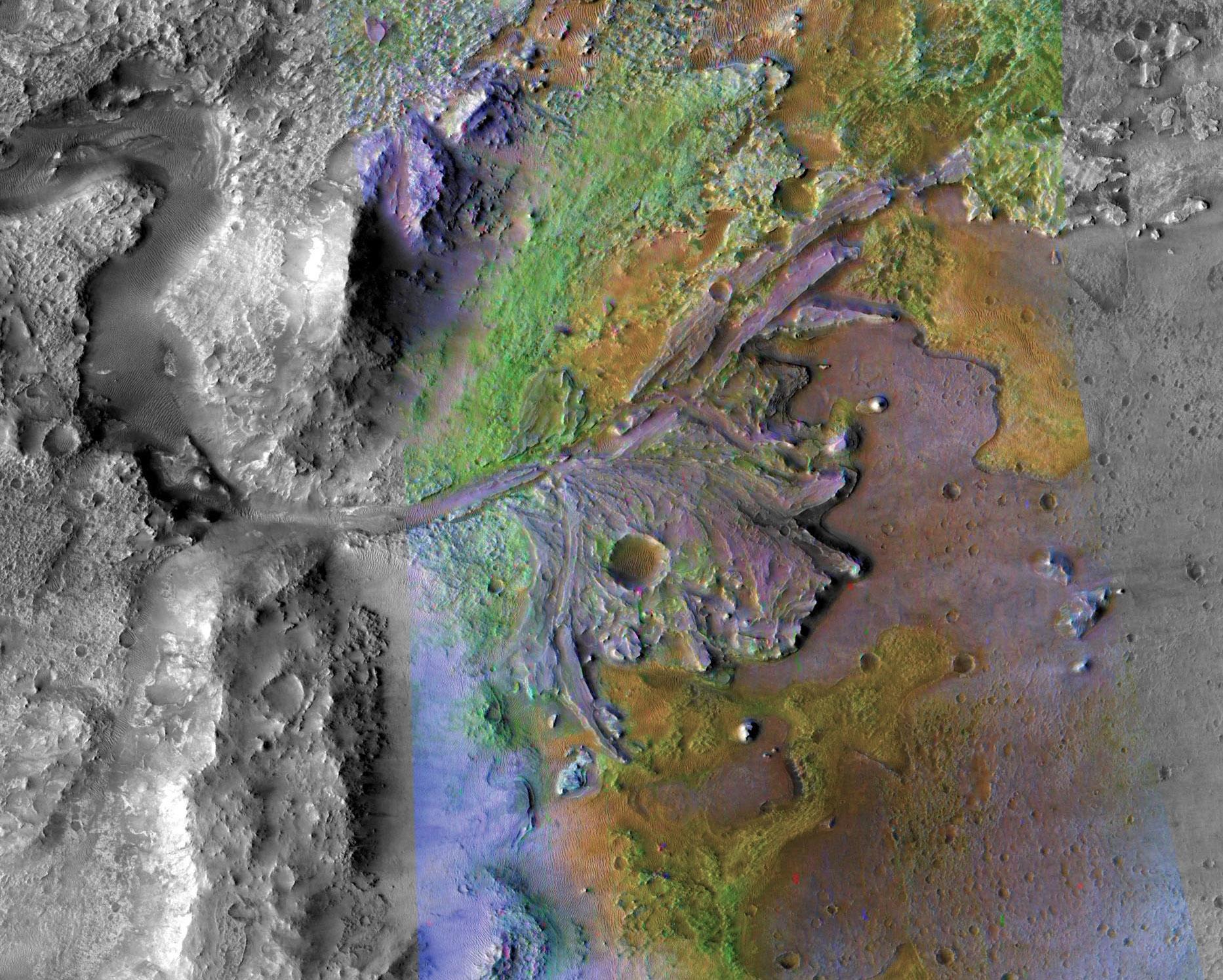
Yet its surface is crossed by dried river valleys. Ancient deltas fan into craters. Minerals formed in water survive inside rocks more than three billion years old.
This is why the question is no longer whether early Mars could hold water.
It could.
The question is whether any of those environments ever became alive—and what evidence would be strong enough to prove it.
That standard matters because Mars has produced decades of seductive clues: methane reports, organic molecules, possible microfossil shapes and one famous hill that looked like a human face.
Some clues became stronger under better instruments. Others disappeared.
To investigate Mars responsibly, habitability, chemistry and life must remain three different claims.
Habitable Is Not Inhabited
A habitable environment contains conditions that could support life as we understand it.
That usually means liquid water, useful elements, an energy source and enough stability for chemistry to continue.
Ancient Mars met parts of that test in multiple places.
NASA’s Mars programme treats the search for past life as a sequence: reconstruct the climate and geology, identify habitable environments, look for possible biosignatures and then test whether non-biological processes can explain them.
Earth supplies the warning.
Many lifeless environments contain water and organic carbon. Lightning, radiation, volcanic chemistry and meteorites can all build complex molecules without cells.
So the existence of an ancient Martian lake is an important beginning, not an answer.
The Lakes Of Gale And Jezero
Curiosity explored Gale Crater and found mudstone deposited in an ancient lake.
The Cumberland sample contains clay minerals, sulfur compounds and nitrates—ingredients and preservation conditions that make the rock scientifically valuable.
Perseverance landed in Jezero Crater because a river once entered the basin and built a delta.
Sedimentary rocks can trap material carried through a landscape and bury it in fine layers. Carbonates and clays can preserve chemical patterns that would be destroyed at the exposed surface.
These settings tell us that early Mars was not one uniform wasteland.
It had changing lakes, floods, volcanic rocks, groundwater and long intervals of alteration.
If life arose, lake margins and buried sediments are among the places where traces might survive.
The Organic Molecule Problem
Organic chemistry is chemistry built around carbon.
Life uses organic molecules, but life does not own them.
Curiosity and Perseverance have detected several classes of Martian organics.
In 2025, scientists reported decane, undecane and dodecane in Curiosity’s Cumberland sample—the largest organic molecules yet identified on Mars.
A 2026 follow-on study tested several non-biological sources and concluded that those sources did not fully explain the estimated original abundance.
That makes a biological origin reasonable to investigate.
It does not make it established.
The rock has been exposed to radiation for millions of years. The molecules are fragments. Their original structures and pathways are uncertain.
One result can raise the probability of biology while remaining far from proof.
What Would A Biosignature Look Like?
A strong biosignature is not simply something life can make.
It is a pattern that life explains better than known non-biological processes.
Possible lines of evidence include cell-like structures with consistent biology, isotope ratios produced by metabolism, mineral textures associated with microbial growth and families of molecules showing biological selection.
Context is essential.
A shape inside a crack may be mineral growth. A methane pulse may be geological. A carbon ratio may be altered by radiation or water-rock reactions.
The strongest case would combine morphology, chemistry, isotopes and geology in the same sample.
Independent laboratories would need to reproduce the result while blanks and witness materials ruled out Earth contamination.
Life detection is therefore less like spotting a fossil and more like building a prosecution from many witnesses.
The Face, The Fossil And The Human Eye
In 1976, a Viking image of Cydonia showed a kilometre-scale hill that resembled a face.
The image had coarse resolution, low sunlight and transmission artefacts. Shadows appeared to create eyes, a nose and a mouth.
Higher-resolution images from Mars Global Surveyor, Mars Odyssey and HiRISE resolved an eroded mesa under different lighting.
No walls, carving plan, repeated geometry or associated settlement emerged.
The feature remains interesting as geology and as a lesson in perception.
Human vision is built to find faces quickly. That ability keeps us socially alert, but it also creates patterns where none were designed.
A possible Martian fossil must survive more than resemblance.
It must have structure, composition, context and a formation history that geology cannot reproduce.
Why Samples Matter
Rovers are laboratories, but they operate under severe limits.
They carry miniature instruments, analyse tiny targets and cannot repeat every test with a completely different technique.
Returned samples would allow high-resolution imaging, isotope measurements, molecular separation and experiments that cannot fit inside a rover.
They would also create a new problem: proving that any biological signal did not come from Earth.
That requires sealed handling, contamination knowledge, multiple facilities and transparent replication.
ESA’s Rosalind Franklin rover takes a different route by planning to drill below the radiation-damaged surface for better-preserved material.
Whether through drilling or return, the aim is the same: move from intriguing chemistry to testable biological history.
The Answer
Was Mars ever alive?
The honest answer is that we do not yet know.
We know ancient Mars had water-rich environments that could have supported microbial life.
We know organic chemistry survives in Martian rocks, including molecules more complex than scientists once expected to find.
We also know that every current clue has plausible uncertainty.
The Face is geology. Organics are not organisms. Habitability is not habitation.
A convincing discovery will probably not arrive as one photograph or one headline.
It will arrive as several independent measurements pointing to the same biological process while serious non-biological explanations fail.
Mars has earned its place as the best-tested possibility for ancient life beyond Earth.
It has not yet earned a verdict.